Youth Skills in 2035: Where Will Future Jobs Come From?

Challenge 6 • World Bank Data Dive 2025

Team Upskilling Labs

2025-01-01

Team Upskilling Labs

  • Madhu Jalan
  • Ashley Nalikka
  • Sandra Moscoso
  • Jennifer Kemp
  • Chidubem Nwabunze
  • Tiveeda Stovall
  • Gareth Digby

Team Upskilling Labs

The Problem

  • By 2035, global labor markets will be radically different.
  • Youth supply (15–24) shifts dramatically across regions.
  • Skills, not just population, will decide who benefits from digital/AI jobs.

Key Question:

Which youth skills will matter most in 2035 — and where will they be located?

Our Data Approach

List datasets merged:

  • UN population projections
  • UN education shares
  • World Bank attainment levels
  • Projections to 2035
  • Scenario 2 (medium variant)

Outputs:

  • Absolute youth by skill
  • Regional profiles
  • Gender gaps
  • Country leaders
  • Risk outliers

Tools used:

  • ChatGPT
  • Claude
  • Databricks
  • Tableau

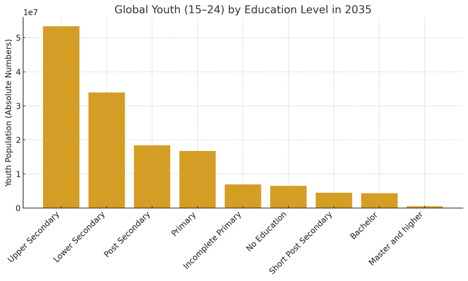
The Global Pyramid of Skills (2035)

Global education pyramid
Insight: Upper Secondary is the world’s dominant education level.

Where Are Gender Gaps in Education Closing Fastest?
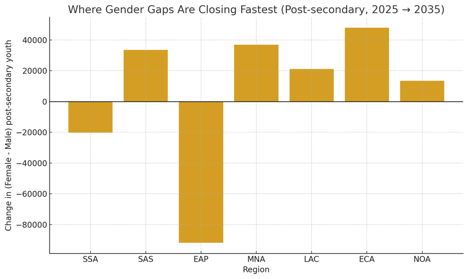
Where Are Gender Gaps in Education Closing Fastest?

Gender parity in education is improving in most regions — but Sub-Saharan Africa and East Asia are falling behind, risking long-term inequality in future job markets.

Region Comparison: Post Secondary Educated Youth
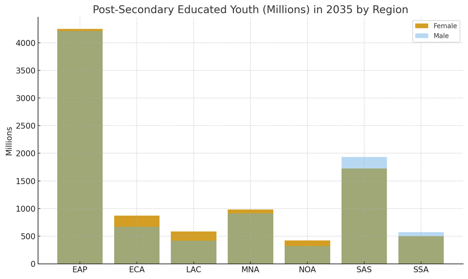
Region Comparison: Post Secondary Educated Youth

By 2035, East Asia & Pacific will have the world’s largest pool of post-secondary educated youth, while women will lead in North America, Latin America, Europe & Central Asia — and men remain ahead in South Asia, MENA, and Sub-Saharan Africa.

Master’s or Higher Students in 2035

Top 5 and Bottom 5 countries, largest number of Master’s or Higher Students

Live Dashboards in Tableau
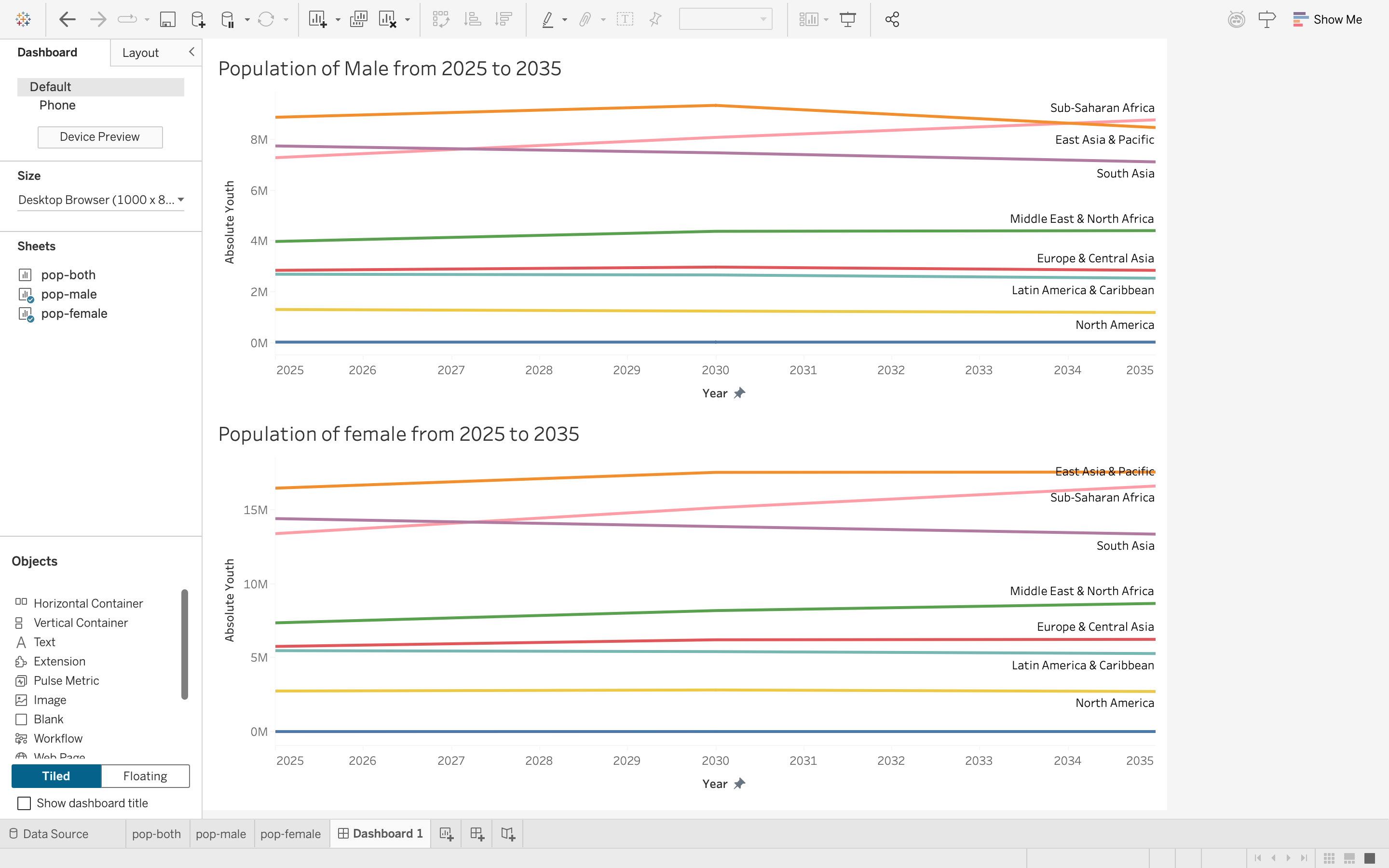
Tableau live dashboard

So What? Policy Recommendations

  1. Scale post-secondary vocational/digital tracks in Africa + South Asia
  2. Invest in gender-equal talent pipelines where women already lead
  3. Target global talent hubs — Asia dominates the 2035 supply

“The future of jobs will be decided by where youth skills grow fastest — and our data shows exactly where that is.”

…To Be Done!! …

The following need their charts!

Region Comparison: Skill Profiles

Chart: Regional heatmap
Highlight:

  • Asia = huge mid/high skill base
  • Africa = dual challenge (high low-skill + rising mid-skill)
  • LAC/ECA = modern skill distribution
  • MENA = rising mid-skill, lagging tertiary

The Geography of Global Talent

Chart: Regional share of skilled youth (2035)
Insight:

  • EAP = 48% of global skilled youth
  • Asia = ~65% combined
  • Talent is geographically concentrated

Growth 2025 → 2035

Chart: Post-secondary & Upper secondary growth by region
Insight:

  • SSA & MENA = fast growth but low base
  • EAP = biggest absolute gains
  • LAC/NOA stagnate

Gender Shifts: Women Rising

Chart: Countries where young women > men in post-secondary
Insight:

  • Women surpass men in many major economies
  • The “future skills gap” is increasingly male

Country Leaders & Risk Outliers

Two short lists:
Leaders (Tertiary): CHN, USA, EGY, RUS, IDN, BRA, MEX
Outliers (No Education): NGA, DZA, IRQ, AFG, ETH, etc.

Insight:

“Large populations ≠ large skilled populations.”